How AI Thinks (Just Enough)
Three Mental Models
You don't need to understand how AI works under the hood. But knowing three things about how it behaves will save you a lot of frustration today and help you troubleshoot when something feels "off."
1. Probabilistic: Different Every Time
If you asked five different people to summarize the same article, you'd get five different summaries. All accurate, but each one different. AI works the same way.
The same prompt does not always produce the same output. This is called being probabilistic: AI generates responses based on probability, not exact formulas. There are many possible good answers to any question, and each time you ask, AI picks a slightly different path.
Takeaway
- "It worked yesterday" doesn't guarantee it will work the same way today
- Two teammates using the same prompt will get different (but both valid) results
- Variation is a feature, not a bug, because it means you can iterate and refine
You control how much variation you get. Think of every prompt as defining a space of possible answers. A vague prompt like "tell me about trees" opens a massive space. AI could go in hundreds of directions, so each time you ask, you'll get wildly different results. A specific prompt like "list five trees that produce edible fruit in a temperate climate, with the best time of year to harvest each one" shrinks that space dramatically. The answers still vary, but they cluster around what you actually want.
This is why the Three Pillars from the previous section work. Scope, Intent, and Structure aren't just formatting tips. They're how you control the variation. Leave them vague and you get surprise. Make them specific and you get useful variety.
2. Stateless: A New Person Every Time
Every conversation with AI starts from scratch. It has no memory of previous conversations. The technical term for this is stateless: it does not retain any information from one session to the next.
Think of it like...
Meeting a new person who has never spoken to you before. Every. Single. Time.
Takeaway
- If you close a chat and start a new one, everything from before is gone
- AI won't remember what you built last session or what decisions you made
- You need to re-explain context at the start of each new conversation
A note on memory: As of March 2026, some AI chat tools have begun to incorporate cross-conversation memory. These tools can retain certain information between conversations, but they work by saving key facts, not replaying the full chat history. For now, treat each new conversation as a blank slate. If you need AI to know something, tell it directly.
Later in Lesson 3, you'll learn how to give AI persistent instructions so it starts every conversation already knowing about your project.
3. Context Window: The Oxygen Tank
During a single conversation, AI can only hold so much in its "working memory." This is called the context window, and it's measured in tokens, small chunks of text (roughly 3/4 of a word).
Think of your context window like an oxygen tank. As you talk back and forth, the tank fills up. Eventually, you need to surface for fresh air. Start a new conversation so AI can focus clearly again.
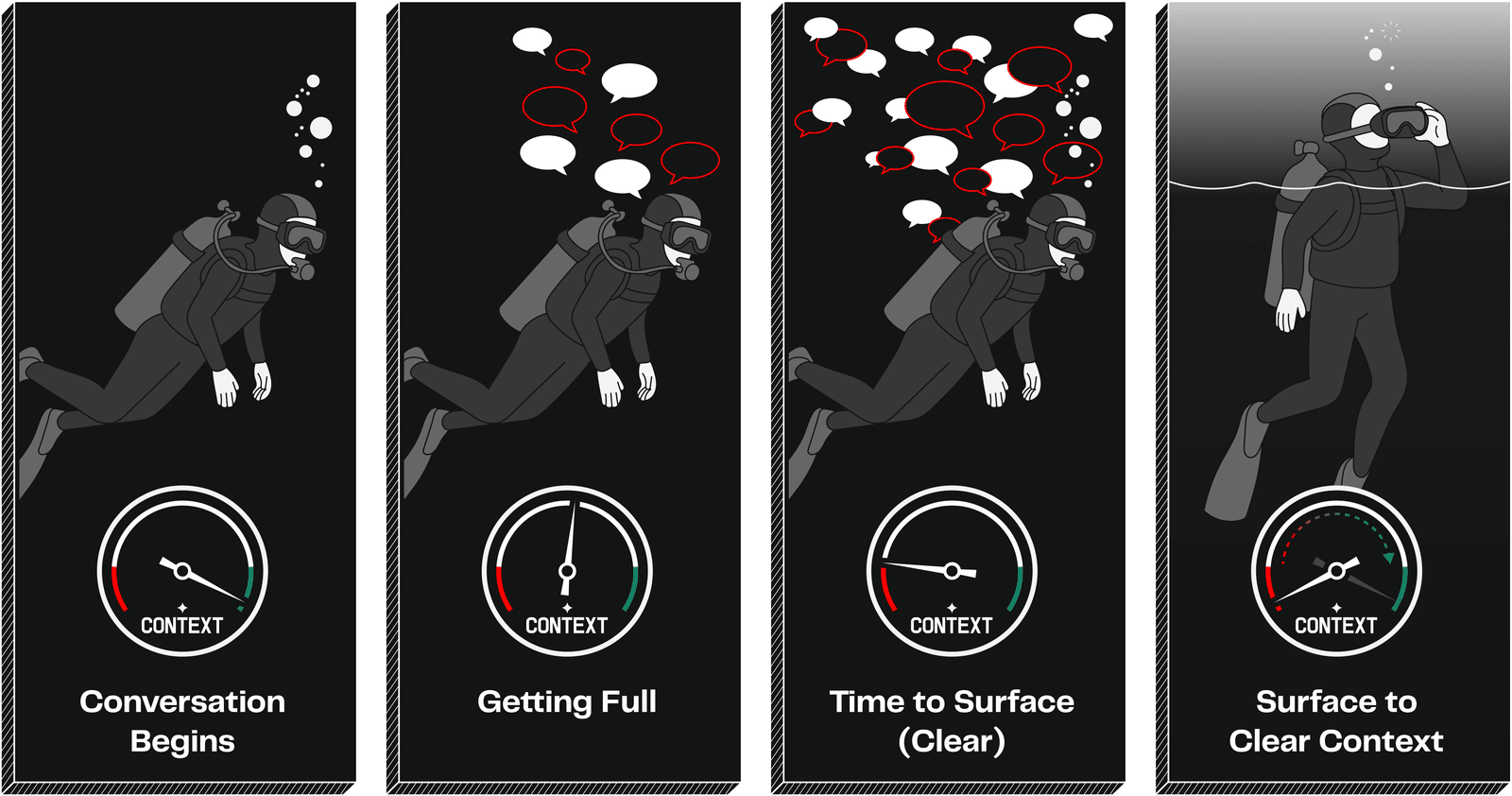
When the tank gets full:
- AI starts paying less attention to things in the middle of the conversation
- Response quality can fade
- AI might "forget" things you told it earlier in the same chat
When to start fresh: If you've had 15+ back-and-forth exchanges and AI's responses start feeling repetitive or off-target, that's your signal to start a new conversation.
How to start fresh:
In Your AI Assistant
Click New chat in the left sidebar. Your previous conversation is still there if you need it; just click it in the sidebar to pick up where you left off.
Click New chat in the left sidebar. Your previous conversations stay in the sidebar, so you can always go back to one if you need to continue it.
Starting fresh doesn't lose any work you've saved in your project. It only clears the conversation itself, giving AI a full tank again.
Ask Twice, Get Two Answers
Team Activity | ~3 minutes total | Everyone works individually, then regroups.
Each person on the team opens their AI chat tool and asks the same question:
Each person on the team opens their AI chat tool and asks the same question:
What are the three most important things to know before attempting a
multi-day backcountry route in Yellowstone?
!!! ai-assistant "In Your AI Assistant"

    === "Claude.ai"

        Go to [claude.ai](https://claude.ai){:target="_blank"} and paste the question into a new conversation.

    === "ChatGPT"

        Go to [chatgpt.com](https://chatgpt.com){:target="_blank"} and paste the question into a new chat.

**Regroup**: Compare what everyone got. Did you all get the same answer? That's **probabilistic** in action: the same input can produce different outputs. If you opened a new conversation and asked the same question again, you might get yet another answer. And each new conversation has zero memory of the last one. That's **stateless**.

Once you know what you want to build and write it as a user story with acceptance criteria, you'll constrain the variation with specificity. That shift from "explore" to "build" is the workflow you'll practice next.
Key Insight
AI is probabilistic (different every time), stateless (forgets between conversations), and has a limited context window (the oxygen tank). None of these are flaws; they're just how it works. Knowing this means you won't be surprised when AI gives you a different answer today than yesterday, or when it "forgets" something you told it three conversations ago.