Frequently Asked Questions
Everything you need to know before (and during) the Impact Lab. Read through this page before the Impact Lab begins. It'll save you a lot of "wait, what?" moments.
The Basics
What is the Impact Lab?
The Impact Lab is a hands-on event where you build real software using AI tools. You'll work in a small team, follow a structured learning path, and ship a working product.
What do all these terms mean?
| Term | What It Means |
|---|---|
| Field Guide | This website: your curriculum, your schedule, these FAQs, and everything you need to orient yourself during the Impact Lab |
| Track | Your assigned path through the Impact Lab. Four tracks are offered (Beginner, Intermediate, Advanced, Expert); depending on the event, some tracks may be locked. Your track groups people with a similar experience level together. The curriculum, the challenges, and your teammates all reflect the level of experience you're coming in with. |
| Lesson | Guided online curriculum you go through with your team. Structured teaching that introduces new concepts and builds mental models. (Team activity) |
| Challenge | A hands-on build challenge where your team applies what you just learned, with room for creativity and different approaches. Each Challenge builds on the last. (Team activity) |
| Reflection | A room-wide debrief where the whole cohort comes back together to discuss what worked, what didn't, and what surprised you. (Cohort-wide activity) |
| Session | One complete loop: a Lesson, a Challenge, and a Reflection. Each Session is time-boxed, and each track goes through four Sessions across the Impact Lab. |
| Facilitator | Your cohort leader: facilitates timing, leads discussions, collects feedback, and is there to support you when you need help |
| Showcase | Some Impact Lab events end with a Showcase, where teams demo what they built and explore what other teams created. It's an opportunity to celebrate what everyone accomplished. |
The flow is always the same: Lesson, then Challenge, then Reflection, repeated four times across the Impact Lab.
What am I actually building?
Working software built around a real problem. Each track builds something different, at a different level of complexity.
You don't need any prior knowledge of the domain going in. Your AI assistant does, and learning it together is part of the experience.
What do I take home?
New skills, new confidence, and the experience of shipping real software. By the end of the Impact Lab, you'll have built and deployed a working application, but the real takeaway is what you learned along the way. The Impact Lab teaches three things:
- How to communicate with AI tools so they build what you actually want
- How software gets built and shipped, from first idea to live deployment
- How to collaborate as a building team, making decisions together and dividing work effectively
You'll leave with hands-on experience using professional AI workflows, a feel for how AI thinks, and the confidence to apply these patterns to your own projects the day you get back to work.
The Learning Journey
How do Lessons, Challenges, and Reflections work together?
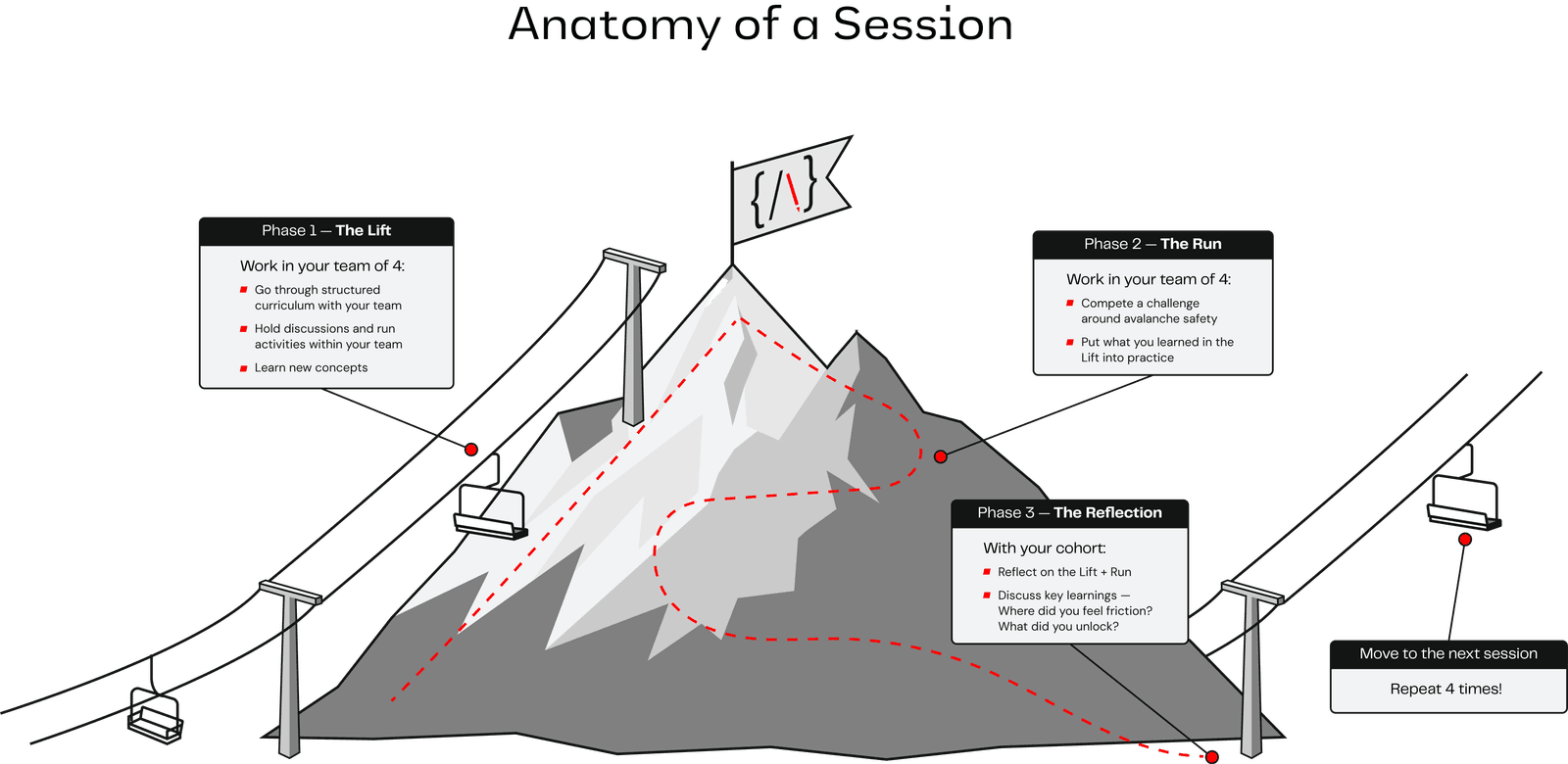
Lessons teach new concepts through structured curriculum. Your team reads together, pacing yourselves through team activities built into each section. Challenges put those concepts into practice through a building challenge, with room for creativity. Reflections bring the whole cohort back together to debrief.
This loop is called a Session. You'll go through four Sessions across the Impact Lab. The challenges are intentionally designed so your team hits a wall, and the next Lesson gives you the tool to break through it. That's how skills stick.
What if I don't understand everything in a Lesson?
That's okay. The goal is to get enough conceptual grounding to put things into practice during the Challenge, not to master every detail. If you're stuck on one concept, absorb what you can and move on. The Challenge is where things start to click, and the next Lesson builds on what you've experienced, not what you've memorized.
What's the Showcase?
After your final reflection, some Impact Lab events shift into a Showcase. Split your team in half: one half stays at your table to showcase what you built, demo it, and talk through your journey with visitors. The other half explores what other teams built and learned.
Rotate regularly so everyone gets a turn presenting and everyone gets a turn exploring. It's a more informal, social stretch of the event.
How Teams Work
How big are the teams?
We're aiming for three to four people per team. Some teams may have a different number. Do your best with the people you've got.
How do pacing and scheduling work?
Each Lesson-and-Challenge pair is combined into one time block for your team. We recommend spending roughly 30 to 40 minutes on the Lesson and then moving to the Challenge so you get a good balance of conceptual learning and hands-on practice. Regroup with your team at the bottom of every page of the Lesson before moving on.
Team activities are built into the guides to help keep everyone in sync. Your teammates will have different skills and backgrounds. That's intentional. Coach each other.
Sessions are time-boxed and the whole cohort moves through the curriculum on the same schedule. Some teams will build more, some less. That's normal. Reflections are not flexible: the whole cohort comes back together in the room, so be ready when yours starts. If you finish a Challenge early, pursue the stretch goals. Don't advance to the next Lesson.
What if we're falling behind?
That's okay. The goal is learning, not finishing. Understanding what you built and why it works matters more than checking every box.
Focus on the baseline capabilities. Skip the stretch goals. Ask for help. And show yourselves some kindness. You're learning new skills, and that's genuinely hard.
How should we collaborate during challenges?
That's up to you. Some teams mob (everyone around one screen). Some pair up. Some divide and conquer. Experimenting with different collaboration styles is part of the learning.
The one rule: each challenge produces one deliverable per team. One demo, one repository, one product. How you get there is your call.
Who should be driving?
Everyone. Rotate who has hands on the keyboard so everybody gets practice. Don't let the person with the most experience do all the typing. The goal is learning, and you only build that muscle by being the one at the keyboard.
Getting Help
Where do I go when I'm stuck?
Here's how to get help, in this order:
- Ask your AI assistant. Think of it as a co-worker who knows everything. Build the habit of going here first.
- Ask your Facilitator. If your AI assistant can't help, your Facilitator is there for exactly this. For technical issues (workspace won't load, something is broken), your Facilitator can escalate to event support staff.
The only wrong move is sitting stuck in silence.
Your AI Assistant
Should I ask my AI assistant before asking a person?
Yes. Your AI assistant knows more about the topics you'll encounter than most people at the event: technical questions, domain questions, debugging, and the specific domain you're working in. Start there. This is about building muscle memory for a new way of working. If you flag down a Facilitator, the first thing they'll ask is: "Did you ask your AI assistant?"
What's wrong with copy-pasting a huge prompt to build everything at once?
It won't teach you anything. We call this one-shotting: dumping a massive prompt into AI and accepting whatever comes back. You'll get output, but you won't understand it, and you won't develop judgment for when AI nails it versus when it needs a nudge.
The value is in the back-and-forth. Work in small chunks. Send a prompt. Look at what comes back. Give specific feedback. That cycle (prompt, evaluate, refine) is the skill that transfers to everything you'll do with AI after this event. The lessons will teach you how.
Mindset
Is this a competition?
No. The goal of the Impact Lab is learning, not building the most. If your event includes a Showcase, every team shares what they accomplished: the skills they developed, the challenges they overcame, and what they built along the way. It's a chance to celebrate how far everyone came and see what others achieved.
We hope you leave the event proud of what you accomplished. The real story is the journey: where you started, what you figured out along the way, and the skills you're taking home.
What if I'm struggling?
That means you're learning. There's a lot that's new today, and some of it will feel scary, confusing, or overwhelming. That's expected. You may get frustrated. You may wonder why another team seems to have it all figured out. (They don't.)
Grit: having the courage to do hard things, because you only grow by pushing through challenges you haven't faced before. And growth mindset: learning new skills can be humbling and frustrating, and that's all part of the journey. The Impact Lab is designed to give you the easiest on-ramp possible, but it's still a real learning curve.
Show kindness to yourself and to your teammates. Celebrate small wins. Ask for help. The real deliverable isn't the software. It's the skills you're developing and the confidence you're building.